Sunday, 26 March 2017

7 Surprising Arthritis Symptoms Every Woman Needs To Know

From prevention.com

You know sore, achy joints are arthritis's hallmark. But pain isn't the only symptom an arthritis sufferer may have to contend with.
"In a lot of cases, people notice other things showing up before they ever have pain," says Kevin Shea, MD, an orthopedic surgeon at St. Luke's Health System in Boise.
There are more than a dozen different types of arthritis, and Shea says each type is associated with its own set of symptoms. Also, every individual arthritis sufferer may experience the disease in her own way, he adds.
Why keep an eye out for these symptoms? "Depending on the type of arthritis, if you catch it early your doctor may be able to help you slow its progression," Shea says. Early detection could also give your doc the chance to administer anti-inflammation drugs, or recommend lifestyle changes that will keep you on your feet and active.
So what are those non-pain symptoms you need to watch out for? Keep reading.

Stiffness
For a lot of people, arthritis begins as feelings of joint stiffness. "You try to bend or straighten the joint, and it feels tight or full," Shea says. "It also may be hard to move to one side." This stiffness could strike any time (or all the time), but tends to be worse early in the day—before you've had time to "warm up" your joints, he adds. These 7 stretches can help ease your arthritis pain.

Swelling
Compare your left wrist or knee to your right. If one looks bigger or puffier than the other—and assuming you didn't recently sprain or injure the joint in question—that swelling could indicate arthritis. "Sometimes people notice the swelling more towards the end of the day," Shea says. You may also find that the swelling accompanies feelings of joint stiffness.

Catching Or Grinding
If your knee or wrist ever feels like its tendons are somehow tied up or "catching" on one another, that's another early symptom, Shea says. "Sometimes a patient will notice the catching or grinding, and then the pain will come later," he explains.

Fatigue
Unlike degenerative arthritis, which is basically "wear and tear" that slowly breaks down the padding of your joints, rheumatoid arthritis is a condition in which your body's immune system attacks your joints, Shea says. This could lead to inflammation, both acute (in or around your joint) and systemic (throughout your body). Systemic inflammation related to rheumatoid arthritis could leave you feeling unusually wiped out or fatigued.

Fever Or Loss Of Appetite
These are two more symptoms associated with the kind of systemic inflammation that stems from rheumatoid arthritis (RA). Because RA sufferers tend to experience "flare-ups," or periodic increases in inflammation, these symptoms may be strong at times and absent at others, says the Arthritis Foundation.

Redness Or Skin Rashes
In some cases, arthritis sufferers may notice their joints look red or irritated—even if they aren't hurting, Shea says. Also, a form of the disease called "psoriatic arthritis" can cause red, flaky, scaly skin issues.

Poor Range Of Motion
Your wrist or ankle seems less mobile than it used to be. Or maybe you reach for a high shelf, and your shoulder doesn't want to lift your arm above your head. These and other range-of-motion issues—especially if accompanied by pain—are often associated with arthritis, Shea says.

http://www.prevention.com/health/7-surprising-arthritis-symptoms/slide/7

Thursday, 23 March 2017

Surgery and Other Treatment Options for Arthritis Patients

From food.ndtv.com

Arthritis in the knee is the most common type is osteoarthritis which is a progressive condition that slowly wears away the joint cartilage. It is mostly likely to strike after middle age but can also occur as a result of injury or if a person is overweight. When the cartilage gets destroyed, the bones of the joint rub constantly against each other and this may lead to swelling, pain and stiffness.

While age seems to be the most common cause of knee arthritis as the ability of the cartilage to heal diminishes when people get older and it may not be able to repair itself after the regular wear and tear, there are other factors that can also put you at risk. Obesity, people who are involve din athletics or some kind if genetic mutations may make a person more likely to develop knee arthritis.
Knee arthritis may bring a lot of pain to the patients and they may also lose mobility or find it difficult to walk. Therefore, the primary goal of treatment is to deal with these issues. Here are some common methods of treating knee arthritis. Be sure to take your doctor's decide before you decide to follow any of these as the treatment option totally depends on the severity of the condition.

1. Pain Relievers and Anti-Inflammatory Drugs:
Consult your doctor who may prescribe certain medications to relieve the pain and control the swelling.

2. Injections: Some doctors may suggest getting injected with corticosteroids or hyaluronic acid that helps in lubricating the joints and lessening the effects of the constant rubbing of bones.

3. Physiotherapy:
Some easy exercises can help in strengthening your muscles and increase the flexibility in your joints. Some amount of physical stress can also help in easing out the symptoms of knee arthritis like pain, swelling and stiffness.

4. Weight loss:
One of the main causes of knee arthritis may be excess weight that puts an extra load on your knees leading to discomfort. The inflammatory mediators produced in fat can cause your joint tissues. In such a situation, weight loss can help in improving the joint functions.

5. Surgery: In severe cases, a 'total knee replacement surgery' may be recommended by doctors. Depending upon the degeneration of the knees, doctors may also suggest arthroscopes or partial replacements.

http://food.ndtv.com/health/knee-arthritis-5-ways-to-get-it-treated-1672610

Sunday, 5 March 2017

Men 'face unique challenges when coping with rheumatoid arthritis'

From arthritisresearchuk.org

Men with rheumatoid arthritis are often struggling to cope with their condition due to unique challenges created by their identities and self-perception, according to a new study.

Research carried out by the University of West England and funded by Arthritis Research UK has indicated that men face specific problems when dealing mentally with rheumatoid arthritis that women do not share - and that tailored channels of support may be needed to help them cope.
The unique struggles faced by men The study centred on a series of interviews carried out among six focus groups comprising 22 men, who were asked about their experiences and the impact their conditions have on their lives.

Their responses revealed that many men find that rheumatoid arthritis poses a challenge to their perceptions of their own masculinity, as the reductions in strength and abilities that the disease causes can lead to a loss of independence, undermining their desired social roles and causing them to feel powerless and out of control.

While some sought out information on how to manage their condition better, others had less productive coping methods, including adopting a "just get on with it" approach that often included social withdrawal or destructive behaviour such as excess drinking or physical overexertion.

The study group also indicated that many men lack support structures outside their immediate family, with the majority saying their friends were not understanding of their struggles.

What can be done to provide better support?
Although the study highlighted the fact that men often find it difficult to deal with their condition, the survey responses offered a mixed outlook on what should be done to address the problem.

A preference for information-giving sessions rather than a discussion group was expressed, although there was no strong consensus on whether these should be mixed-sex or men only, or who should run the sessions.

The researchers concluded: "Further research is needed to investigate whether these findings exist in a larger sample and whether the support preferences of men with rheumatoid arthritis are broadly different from those of women with rheumatoid arthritis to decide whether there is a clinical need to design a service for the potentially different needs of men."

Arthritis Research UK's view "Millions of men and women with arthritis wake up every morning facing the day in pain. We know from speaking to people with arthritis that they are more likely to have a lower quality of life than those without the condition, and that their mental health is negatively affected as a result.

"Currently, men with arthritis are outnumbered by women three to one: this means that men can sometimes be a forgotten group. This research highlights the need to tailor support for men so that they can access the information and support they need to live well with rheumatoid arthritis."

http://www.arthritisresearchuk.org/news/general-news/2017/february/men-face-unique-challenges-when-coping-with-rheumatoid-arthritis.aspx

Friday, 17 February 2017

Your Guide To Managing Arthritis Pain

From Marilyn.ca

What is arthritis? Arthritis actually means joint inflammation. However, the definition of arthritis also includes rheumatic diseases, which are conditions that affect joints, the tissues that surround joints and other connective tissues. There are more than 100 different types of the disease which share some element of joint and musculoskeletal pain. The pattern, severity and location of the symptoms can vary depending on the specific form of the disease. A common misconception of arthritis is that it is a condition of the elderly, when in fact 56% of Canadians with arthritis are under 65 years of age.

What are the most common types of arthritis?
First, osteoarthritis, also known as wear and tear syndrome, occurs when the cartilage or cushion between the joints breaks down leading to pain, stiffness and swelling. People with osteoarthritis have risk factors such as decreased function, muscle weakness and impaired balance; this makes them more likely to fall.
Next there is rheumatoid arthritis (RA). RA is an autoimmune disease in which the body’s immune system, which normally protects itself by attacks foreign substances like bacteria and viruses, mistakenly attacks the joints.

What are the causes of arthritis?
There are various causes of osteoarthritis, the most common are injury and overuse of the affected joints. Being overweight can also increase your risk.
For many forms of arthritis, the cause is unknown. Scientists are studying factors such as genetics, lifestyle, and environment in the various types of arthritis. There is no known cure of arthritis yet, but your pharmacist can help better manage it.

Here are four tips for managing arthritis:
  1. Speak to your pharmacist about your medications effectiveness. Optimal use of your medications can be assessed and reviewed so you can get the most benefit from your therapy. In addition, many pharmacies have devices to make your life easier such as easy open prescription bottles, canes, bath rails and more.
  2. Exercise. Natural endorphins will help with pain relief, improve mood and increase energy. Stretching and flexibility are important to maintain mobility.
  3. Make a point to relax a little every day. Meditate and focus on things you enjoy. Getting a massage and having a good night’s sleep will help to reduce pain and keep stress at bay.
  4. Eat a healthy, balanced diet. avoid comfort foods and weight gain. Do not turn to alcohol or smoking; they can worsen your symptoms.
Foods that can help ease symptoms
  • Omega-3 fatty acids found in fish. Eat 3-4 ounces, twice a week from fish like salmon and tuna.
  • Whole grains, foods high in fibre. Quinoa, wild rice, lentils, and black beans all decrease c-reative protein which promotes inflammation in the blood.
  • Nuts and soy products like tofu or edamame, and garlic and onions. They decrease cartilage damaging enzymes.
  • Green tea can block the production of molecules that cause joint damage.
Foods to avoid: sugar, trans fats, white flour, white rice, gluten and casein. 

Saturday, 11 February 2017

Beat Arthritis by checking your teeth

From thenationonlineng.net

Gum/tooth disease is a common complaint that comes with aging, which is the reason many elderly people lose their natural teeth with age. One thing many physicians and their patients are yet to realize is that tooth/gum trouble is a symptom of a much more serious health challenge. Pain in the joints is a well known symptom of Rheumatoid Arthritis, but a much less known fact is the relationship between arthritis and gum/tooth troubles. Physician/researcher Al Sears points this out when he says, “But one problem with modern medicine is that specialists often miss the bigger picture. Every part of your body is biologically connected. And what’s going on in your mouth can reveal a lot about your health.”
New research studies published in the Nature Reviews Rheumatology journal provide evidence to corroborate Sear’s theory. Sears states, “In a study published just a few weeks ago in the journal Nature Reviews Rheumatology, researchers followed 6,616 people for more than 10 years. They found that those who had moderate to severe gum disease had more than twice the risk of developing rheumatoid arthritis.”
Sears continues, “Other research suggests that clearing up gum disease could help prevent or treat Rheumatoid Arthritis. Case Western Reserve University School of Dental Medicine found that people who were treated for gum disease had significantly more improvement in their Rheumatoid Arthritis symptoms than those who were only treated for their Rheumatoid Arthritis.”
There are a lot of bacteria in your mouth, something like 100 billion bacteria. The bacteria form a sticky film called plaque that hardens into tartar. Plaque and tartar cause inflammation in your gums. If you have plaque and tartar build-up, your gums may bleed when you brush your teeth. But those bacteria can also travel around your body. And left unchecked, they can cause inflammation in other parts of your body, like in your joints.
The good news is that treating gum troubles could treat or prevent Rheumatoid Arthritis. The Case Western Reserve University School of Dental Medicine study found that people who were treated for gum disease had significantly more improvement in their RA symptoms than those who were only treated for their Rheumatoid Arthritis. Sears continues, “Scientists found that one of the bacteria involved in Periodontitis may trigger a process called citrullination. Researchers who study this process believe it’s what sparks the immune system and drives the cascade of events that lead to Rheumatoid Arthritis.”
The secret of Healthy Teeth is therefore Healthy Joints. To prevent and treat your RA, simply take care of your teeth. Besides just brushing and flossing, do the following for healthy teeth AND joints:
  1. Coconut Oil Pulling. Oil pulling is an ancient Ayurvedic detox practice. It pulls toxins out of teeth and gums. And the oil leaves a film on teeth to help prevent plaque and bacteria from sticking. It can reduce both plaque and gum disease in just seven days.
To do this, in the morning before eating or drinking anything, gently swish one tablespoon of coconut oil in your mouth and between your teeth for 10 to 20 minutes. Don’t swallow. Spit the used oil into the trash or a jar, not the sink. It will clog your plumbing. Rinse your mouth and brush your teeth as normal.
  1. Rinse Your Mouth With Aloe. Aloe Vera has 23 polypeptides that stimulate the immune system and fight infections. In a study in India, 345 healthy people used aloe mouthwash twice a day. After just four days, aloe stamped out plaque and gingivitis. It also significantly lowered bleeding and inflammation.

Wednesday, 8 February 2017

Walking: A wonder activity that pays big health dividends

From mtstandard.com

Aspirin is often referred to as a wonder drug, hailed as a medicine that cures many ills. In regard to exercise, walking is aspirin’s equivalent, a wonder activity.
What can walking do for a person? Walking can strengthen the heart and lungs and nourish the joints. Walking can build bones and fight osteoporosis. It burns calories, controls weight, reduces stress and improves your mood. Walking boosts energy.
For those with chronic illness, such as arthritis or diabetes, walking is particularly beneficial to overall health, and safe. With this in mind, the Arthritis Foundation created a program called Walk With Ease, designed specifically for those with chronic illnesses. The Arthritis Foundation underscores how simple walking is.
“Walking is easy to do and doesn’t require a health club membership, fancy shoes or equipment, or special training,” according to an Arthritis Foundation guide to the Walk With Ease program. “You can do it with friends, loved ones, your pet, or on your own.”
More than a year ago, the Butte-Silver Bow Health Department established a program called the Chronic Disease Self-Management Program, which teaches chronically ill people how to self-manage their life-long disease. As part of that effort, the Health Department, in partnership with the Montana Arthritis Program, has also formed the Walk With Ease program.
A new six-week Walk With Ease class begins Monday, Feb. 13 at the Butte Plaza Mall. Coordinator Theresa O’Neill-Dennehy, a certified Walk With Ease instructor, invites those wishing to participate to meet at 9 a.m. at the mall lobby area, near Maurice’s and Payless Shoes. Chronically ill individuals and those just simply wanting to start an exercise routine are welcomed. The program is free.
O’Neill-Dennehy is herself a walker, and quotes Robert Sallis, M.D., with the Kaiser Permanente Center for Total Health in Southern California: “If we had a pill that conferred all the proven health benefits of walking, physicians would prescribe it to every patient, and health care systems would find a way to make sure every patient had access to this wonder drug.”
Despite the benefits to walking, O’Neill-Dennehy said she often hears people say they don’t have time to walk.
“People have difficulty taking time for themselves,” she said. “But think for a minute about the flight attendant at the beginning of a flight — the attendant will explain that in case of an emergency, put your own oxygen mask on first before tending to others. That’s an analogy, but it tells us to take care of ourselves first.”
For the Walk With Ease session beginning Monday, O’Neill-Dennehy asks participants to commit to walking three times weekly for six weeks. She said participants should also commit to making friends.
“Walk With Ease can really be a great social outlet, because we’re all walking together,” she said. “It can really give people a lift, not only physically, but in regard to their mood as well.”

Saturday, 28 January 2017

Suffering From Arthritis? These Foods Help Provide Quick Relief

From boldsky.com

Arthritis means pain and this might be anyplace in the muscles or the bones that the disease affects; the joints particularly endure the brunt and are extremely painful.
This is particularly true if there has been an injury or there are no enough proper nutrients within the body to fix the joint. Damage from this condition could also cause joint weakness and deformities and disrupt daily activities.
A typical treatment of arthritis involves changes in lifestyle and physiotherapy. The last alternative left for the doctors to alleviate the patients from suffering is joint replacement operation.
Today in this article we shall talk about certain foods that if consumed on a regular basis can provide relief from arthritis.

1. Ginger & Garlic: Include more spice into your diet. The ingredients present in these will help to provide relief from arthritis. Include garlic, ginger and onion in your diet. Have these raw with salad or add them to the curries that you are making on an everyday basis. These are highly beneficial in providing relief from joint pain.
2. Ghee: You need some healthy fats to lubricate your joints. Hence, add some ghee or clarified butter to your food as garnishing.
3. Olive Oil: Cook your food in healthy oils like olive oil.
4. Nuts & Seeds: Also have some nuts and seeds like walnuts, cashews, pistachios, almonds, flaxseed, sunflower seeds and sesame seeds. These also provide the required vitamins to the joints and relieve pain.
5. Wholegrains: Always go for whole grain foods and avoid white foods like white bread, etc. Also avoid taking sugar and table salt.
6. Honey: Instead go for natural sources of sweetness like honey, dates, jaggery and brown sugar.
7. Rock Salt: Instead of table salt, go for rock salt or sea salt. These are also high in minerals.
8. Vitamins: Talk to your physician and make sure to take vitamin B12 and vitamin D supplements. The shortage of these two vitamins can lead to joint pain. Avoid sour foods; however, make sure to have vitamin C enriched foods like guava to get relief from joint pain.

http://www.boldsky.com/health/disorders-cure/2017/suffering-from-arthritis-foods-ginger-garlic-help-provide-quick-relief/8-vitamins-pf145055-110375.html

Thursday, 19 January 2017

THE DOCTOR IS IN: Four tips for managing your arthritis in cold weather months

By Dr Adam Parker

Potential links between cold weather and arthritic pain have been studied and debated for years. While there is no definitive link between two, the mind can play a role in how one perceives pain.
Whether or not the cold air is triggering pain in patients with arthritis, it’s easy to get swept up in the holiday season and lack of outdoor activities and forget to properly manage the condition.
Here are few tips that will help make the winter months a little less painful:
1. Find an indoor pool. Swimming is a low-impact activity that is beneficial to the joints. Many local gyms and clubs have indoor pools that are heated. Swimming, water walking and water aerobics are a great way to stay warm and relieve pain.
2. Exercise. Many people let their exercise regimens lapse during the holiday season and winter months. Exercise has a positive effect on range of motion and pain in joints affected by arthritis, so don’t stop moving.
3. Eat healthy. Don’t forget to pack your diet with fish, citrus and green veggies. Fish are full of Omega-3s, which can help reduce inflammation. Citrus fruits such as oranges and lemons are loaded with Vitamin C and leafy, green vegetables like Kale and spinach are laden with Vitamin K. Both can reduce markers of inflammation in the bloodstream.
4. Consider a supplement. If maintaining a healthy diet and exercising on a regular basis aren’t making a significant impact, it might be time to ask your physician if supplements are right for you. It’s important to consult your physician before starting any supplements, so you can discuss how they might affect you and how they might react with any other medications you may be taking.

http://www.stltoday.com/suburban-journals/stcharles/the-doctor-is-in-four-tips-for-managing-your-arthritis/article_86b2e224-f539-52c9-b76c-9078fb942e88.html

Saturday, 14 January 2017

11 best essential oils for arthritis: Control arthritis and inflammation

From belmarrahealth.com

When treating arthritis, essential oils can be an effective home remedy. Research has found that essential oils may aid in symptom relief as they offer anti-inflammatory properties and treat other symptoms related to arthritis (for example, anxiety).
Many patients choose essential oils as a treatment option for arthritis because they are generally safe to use and are associated with minimal side effects.
The use of essential oils is becoming commonplace with the rising popularity of aromatherapy. Aromatherapy uses scent to promote a physiological response. Users report relaxation, stress relief, and overall comfort.
Essential oils can be used in other practices as well, including acupuncture and massage therapy. Many patients combine the use of essential oils with their traditional treatment for extra benefits.

What the research says about essential oils for arthritis

Numerous studies have pointed to the benefits of essential oils in treating and managing arthritis symptoms. A 2010 animal study found that essential oils prevented joint swelling. Even after inflammation peaked, essential oils were found to relieve pain by 68 percent.
Essential oils can also improve emotional health. Arthritis patients often complain about anxiety and stress, but using lavender oil can help combat those emotions to promote calmness instead. In clinical trials, lavender oil was found to successfully reduce anxiety. An alternate study had patients sniff vanilla and found that it greatly reduced stress as well.

How to use essential oils for arthritis

The first and most important point to consider prior to using essential oil is that they must be diluted to avoid irritation, as they are highly concentrated. Common carrier oils you can use to dilute your essential oil are coconut oil, jojoba oil, and olive oil.
For every ounce of carrier oil use about 12 drops of the essential oil.
At first, you should test this combination on an area of your skin and wait 24 hours to determine any possible reaction. If no reaction occurs, your mixture is safe to use.
If you’re using an essential oil for aromatherapy purposes, you can use it directly and either saturate a cotton ball and sniff it or purchase an essential oil diffuser for your home to disperse the scent.

Risks of essential oils for arthritis

Generally speaking, essential oils are safe to use for arthritis treatment, but there are some risks involved. As mentioned, before applying on the skin, essential oils should always be diluted to prevent irritation.
Even with aromatherapy you may develop a headache or become nauseous. This could signal that the scent is too strong or that you need to try a different scent.

11 best essential oils for arthritis

Below you will find the top 11 essential oils to treat and manage your arthritis.
Orange oil: Lowers inflammation and reduces the associated pain.
Ginger oil: Helps reduce pain thanks to its anti-inflammatory properties.
Frankincense oil: May help slow down arthritis progression as it inhibits certain inflammatory processes.
Lavender oil: Promotes calmness, reduces stress, and reduces dull aches and pains.
Cayenne pepper oil: Relieves muscle pain and throbbing sensations by nullifying the effect of compound P (a neurotransmitter).
Rosemary oil: Helps promote circulation and has anti-pain properties.
Chamomile oil: Helps stimulate circulation and promotes detoxification.
Birch essential oil: Reduces muscle, joint, and bone discomfort thanks to its anti-inflammatory, anti-spasmodic, antiseptic, disinfectant, diuretic, and astringent properties.
Lemongrass oil: Can provide long-lasting pain relief and improve mood.
Marjoram oil: Helps ease stiffness and pain, and offers relaxing and calming effects, too.
Basil oil: Contains anti-inflammatory properties to help relieve pain.

http://www.belmarrahealth.com/11-best-essential-oils-arthritis-control-arthritis-inflammation/

Thursday, 12 January 2017

Older adults with arthritis need just 45 minutes of activity per week

From sciencedaily.com

Older adults who suffer from arthritis need to keep moving to be functionally independent. But in an examination of a goal that is daunting for most of this aging population, a new Northwestern Medicine study found that performing even a third of the recommended activity is beneficial.
Federal guidelines suggest achieving 150 minutes of moderate activity per week to prevent premature death and serious illness, however only one in 10 older American adults with arthritis in their knees meet these guidelines. Northwestern Medicine researchers wanted to determine a less overwhelming activity goal to get this population up and moving, and 45 minutes per week was that magic number.
Approximately one third of participants improved or had high function after two years. But those participants who achieved this minimum of 45 minutes of moderate activity, such as brisk walking, per week were 80 percent more likely to improve or sustain high future function over two years compared with those doing less. This finding was true for both men and women.
"Even a little activity is better than none," said first author Dorothy Dunlop, professor of rheumatology and preventive medicine at Northwestern University Feinberg School of Medicine. "For those older people suffering from arthritis who are minimally active, a 45-minute minimum might feel more realistic."
A rare examination of the type and intensity of physical activity older adults need to remain functional, the study was published online Dec. 28 in the journal Arthritis Care & Research.
"The federal guidelines are very important because the more you do, the better you'll feel and the greater the health benefits you'll receive," Dunlop said. "But even achieving this less rigorous goal will promote the ability to function and may be a feasible starting point for older adults dealing with discomfort in their joints."
Federal guidelines suggest achieving the 150 minutes of moderate activity done in sessions lasting at least 10 minutes to promote good cardiovascular health. But Dunlop and her team focused on simply keeping this population functioning over two years.
"We're looking for an older population who can be functionally independent," Dunlop said. "And we were interested in seeing what kind of physical activity might be beneficial to promote good function down the road. We found moderate-intensity activity rather than light activity, such as pushing a grocery cart, to be more valuable to promote future function."
Looking at the intensity of activity that older adults need to achieve to remain functional has not been systematically examined, Dunlop said.
Using sophisticated movement-monitoring accelerometers, the researchers measured the physical activity of 1,600 adults from the nationwide research study, Osteoarthritis Initiative, who had pain, aching or stiffness in their hips, knees or feet.
"We found the most effective type of activity to maintain or improve your function two years later was moderate activity, and it did not need to be done in sessions lasting 10 minutes or more, as recommended by federal guidelines," Dunlop said.

https://www.sciencedaily.com/releases/2017/01/170109150034.htm

Monday, 9 January 2017

Experience The Magic of Ayurveda in Action for Everyday Aches and Pains

By Harshad Jethra

We often suffer from body aches but sometimes the causes are not known to us.
It could be diet, too much exercise or even lack of exercise.
Dealing with body aches could be tough, but going for painkillers is just not the right way to go about it.
Once a while, a painkiller or two might do the trick, but when one gets into a habit, it could be detrimental for our health and well being. And even the immunity could be affected.
While physiotherapy stays as an effective methodology, getting in touch with a physiotherapist could be tough.
In such a scenario, topical medications can work wonders for everyday body aches.
People sometimes consider topical medications to be plain analgesics that work locally without affecting the body, and offer temporary relief from pain and discomfort.
But in essence, by going for a topical medication, one could work very effectively towards healing the damage!
Ayurveda is a rich ancient science which is broadly focused on healing by making use of herbs and herbal treatments. Over centuries, it has worked effectively as a healing methodology.
By using the hidden power of herbs, our body can benefit tremendously. And this can work very effectively even while one suffers from bone damage, while one heals from an accident or if one is bothered by osteoporosis.
There are some very unique advantages that going for an herbal medication offers.
1. This helps one get over the damage which may have occurred to the bones or muscle tissue.
2. Overall health of an individual is accentuated, as herbal products are 100% natural.
3. The risk of occurrence of a side effect is nearly negligible.
4. Even if a side effect does occur, it is possible to overcome the same with minimum efforts, because the side effect is likely to be very mild.
5. These are pretty much effective for allowing one to get over the pain and discomfort as well.
6. Most importantly, an advantage that going for a topical medication offers is that it can act as a simple DIY home therapy for aches and pains.
7. As a medical condition like spondylitis starts healing by itself, you might not feel the requirement to go for specialized treatments.
8. There might be no need to go for pills as well. So you could lead a healthier and happier life, while the healing of the muscuoskeletal disorder takes place.
Just as an example, Kalonji is oil which has been used for healing purposes since ancient times. Alternately, Kalonji seeds very often form a part of diet in India, and even the Middle East.
Black seeds of Kalonji have over a 100 medicinal components. These are antiseptic and are beneficial for disorders like blood sugar, blood pressure and arthritis. This also helps build up immunity.

In particular, when used as a topical medication, the kalonji oil is known to be particularly helpful for curing all bone and muscle related disorders, like back pain, cervical spondylitis, arthritis and spondylitis. Bhairav Oil is a tremendous Ayurvedic remedy which is made from Kalonji seeds as the base material. Other major ingredients of the Bhairav oil are Shudh Gugal and Revendchini, each of which has been listed as a highly effective alternative for treatment of all joint related ailments and disorders.

http://ezinearticles.com/?Experience-The-Magic-of-Ayurveda-in-Action-for-Everyday-Aches-and-Pains&id=9611841

Friday, 6 January 2017

Living with arthritis? Simple lifestyle and exercise tips to improve your joint health

From belmarrahealth.com

Taking care of your joint health should be a priority, especially when you hear about the millions of people living with arthritis. Arthritis is really a term used to describe a lot of joint pain or joint diseases. There are in fact over 100 different types of arthritis and related conditions. What people need to know is that in many cases lifestyle adjustments and exercise can go a long way in improving the health of your joints.
People of all ages and backgrounds get arthritis. In fact, arthritis is the leading cause of disability in the United States. An overwhelming 50 million adults and around 300,000 children do have some kind of arthritis. It is true that it happens more often among the elderly, but the more you know about the condition the better prepared you will be to prevent it, as well as improve your condition if you are ever diagnosed with arthritis.

Simple lifestyle tips for healthy joints

Living with arthritis does not mean that everything stops. Your joint health can be improved or, at the very least, you can prevent further deterioration of the joints by still participating in physical activities. The following exercises for arthritis are what you would call low-key fitness, but they can make a difference. There are also some general tips for arthritis listed here that many people with the condition have found helpful.
Play video games: Today there are gaming systems that get you off the couch. You can play tennis, baseball, and boxing games. Studies show some of these games can burn calories faster than a brisk walk.
Walk the dog: A dog is the perfect motivation for walking every day. The pet needs to burn energy and you need to keep your joints flexible and your muscles strong.
Wash the car: Washing the car means you can get a workout and a shiny vehicle at the same time. Scrubbing and walking around the car is good for the joints.
Make a play date: Get together with some friends and participate in a physical activity together.
Carry groceries. The shopping cart can be a crutch, so instead grab a basket and carry your groceries. The weight adds intensity to walking and helps build strength.
Clean the house: Avoiding this chore is a mistake. Washing windows, hanging laundry, and cleaning the bathroom all count as moderate exercise.
Dance through chores: Some chores do little to raise your heart rate, so when you have to empty the dishwasher, dust, or cook, why not dance around while you do it and get some good exercise?
Get busy in the garden. A rake or shovel can increase your heart rate, improve joint flexibility, and improve muscle strength.
Try volunteering: You can volunteer your time and be active at the same time. Research shows that seniors who volunteer have a better sense of wellbeing.

Hike or ride a bike: If stores, the library, or park are close enough, hike or ride a bike to get there. It will be easy on your joints.
Use stairs: Whenever possible, avoid elevators or escalators and take the stairs.
Park in last spot: When at the mall, office, or market, try parking in the spot farthest from the entrance. Walking is one of the best forms of exercise for arthritis.
Take a class: You can learn a new activity like how to golf or dance salsa.
Make cooking easier: Reorganize the kitchen so that cooking essentials are between shoulder and thigh height. Also, make the counter thigh height since it makes stirring and rolling dough easier.
Open cans and jars. Consider investing in an electric can or jar opener.
Get out of bed easier: Roll onto one side and let your feet over the edge then push up with your torso. Some people install grab bars near their bed to make it easier to get up.
Dress without stress: Wear slip-on clothes instead of clothes that require pulling over the head. Put larger pulls on zippers to make it easier to grasp and choose raglan style sleeves over tailored sleeves. Many people with arthritis find avoiding clothing with buttons is a good idea.

Easy exercises for patients with arthritis

There are exercises that can be too vigorous for those who suffer from arthritis, but they need not be discouraged because there are plenty of other options to consider. For instance, there is the “chair stand” exercise. What you do is avoid flopping down in a chair. Instead, focus on controlling the motion, using your arms to assist you. Repeat the motion of sitting and standing 10 to 15 times. Some people who feel it is too easy, lower the height of their chair.
Here are some other easy arthritis exercises:
Yoga – This can promote a healthy immune system and reduce joint inflammation. The gentle stretching can be good for maintaining movement.
Pilates – This form of exercise helps stabilize your joints and strengthen muscles that support joints.
Water workout – The buoyancy of water can relieve pressure on the joints.
Tai chi – This involves slow, smooth movements that can strengthen the body, improve movement, and reduce arthritis pain. Twenty to 40 minutes of tai chi is a good average for most people with arthritis, but consult with a doctor to make sure.
Hand stretch – With this exercise, you simply spread your fingers as wide as they will go and then make a fist. Repeat the stretching and squeezing motion several times. If you are in the water, you can do this exercise, too. Open and close your hands under water or try squeezing a foam ball. Let the ball absorb water and squeeze it out.
Zumba – This is a Latin-inspired dance/fitness exercise that burns calories and stretches the muscles, but without being too hard on the joints. Most who have tried Zumba say it doesn’t take much time to learn the choreography.
These tips for arthritis are meant to get you moving in a safe way. If you are unsure about what exercise is best for your condition, talk to your family doctor or rheumatologist first. Also, keep in mind when you are new to an exercise you don’t have to do everything all at once. It is okay to do exercises in 10-minute spurts.
Arthritis comes along with an extensive list of symptoms, including swelling, pain, stiffness, and decreased motion. An arthritis diagnosis is scary for people who are used to really active lives, but the arthritis tips we’ve provided should give these people a chance to assess how they can continue to be active and improve their joint health.

http://www.belmarrahealth.com/living-arthritis-simple-lifestyle-exercise-tips-improve-joint-health/

Tuesday, 27 December 2016

Hip pain may be 'hangover from evolution'

From bbc.co.uk

Scientists at the University of Oxford say a hangover from evolution could help explain why humans get so much shoulder, hip and knee pain.
And if current trends continue they predict the humans of the future could be at even greater risk.
They studied 300 specimens from different species spanning 400 million years to see how bones changed subtly over millennia.
The changes came as man began standing up straight on two legs.
Other researchers have noticed similar evolutionary quirks in humans. Some people prone to lower back problems, for example, could have spines closer in shape to those of our nearest ape relative - the chimpanzee.

'Bizarre arrangement'

Dr Paul Monk, who led the research at the Nuffield Department of Orthopaedics, Rheumatology and Musculoskeletal Sciences, was interested to explore why patients in his clinic came in with similar orthopaedic problems.
"We see certain things very commonly in hospital clinics - pain in the shoulder with reaching overhead, pain in the front of the knee, arthritis of the hip, and in younger people we see some joints that have a tendency to pop out.
"We wondered how on earth we have ended up with this bizarre arrangement of bones and joints that allows people to have these problems.
"And it struck us that the way to answer that is to look backwards through evolution."
The team took detailed CT scans of 300 ancient specimens housed at the Natural History Museum in London, in Oxford, and the Smithsonian Institution in Washington.
Bringing the data together, they were able to create a library of 3D models, and spot changes to the shapes of single bones over millions of years.


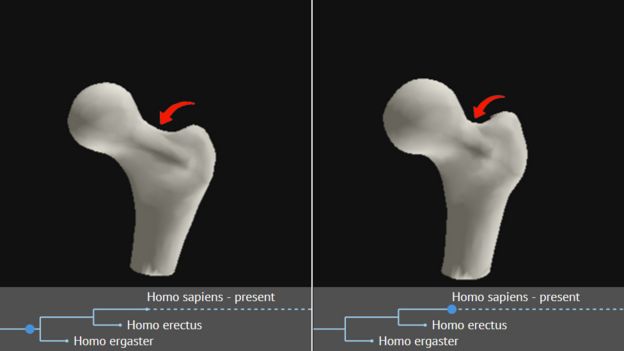
A computer model showing representations of the shape of the thigh bone changing over time
Image caption The thigh bone changing over time
As species evolved from moving around on four legs to standing up on two, for example, researchers say the so-called neck of the thigh bone grew broader to support the extra weight.
And studies show that the thicker the neck of the thigh bone, the more likely it is that arthritis will develop.
Scientists say this is one potential reason why humans are susceptible to so much hip pain.
The team then used their data to hazard a guess at the shape of human bones 4,000 years in the future - although they admit there are many uncertainties in future times that could not be accounted for.
Dr Monk said: "What is interesting is if we try and move these trends forward, the shape that is coming has an even broader neck and we are trending to more and more arthritis."
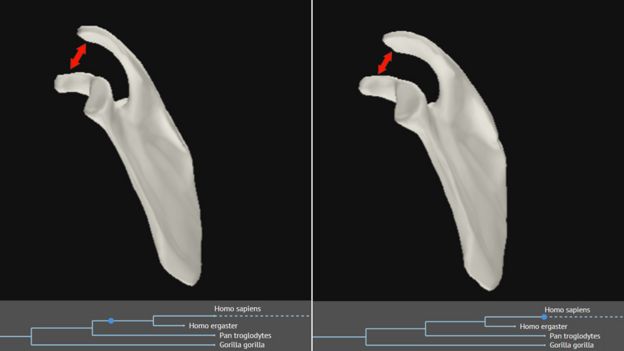
In the shoulder, scientists found that a natural gap - which tendons and blood vessels normally pass through - got narrower over time.
The narrower space makes it more difficult for tendons to move and might help explain why some people experience pain when they reach overhead, say the scientists.
A computer model showing representations of the shape of the shoulder changing over time

Image caption The shape of the shoulder changing over time.

Using these predictions, the researchers suggest joint replacements of the future will have to be re-designed to accommodate the evolving shapes.

But they say it is not all bad news - the right physiotherapy and working on maintaining a good posture can help mitigate some of the downsides of our design.

http://www.bbc.co.uk/news/health-38251031