Showing posts with label medication. Show all posts

Friday, 2 January 2026

Psoriatic arthritis medications: A comprehensive guide

From krdo.com

Psoriatic arthritis is an autoimmune condition that causes joint inflammation, skin symptoms, and pain. People searching for psoriatic arthritis prescriptions are often looking for detailed information about medication options, their effectiveness, potential side effects, and ways to manage costs.

This guide from SaveHealth, a prescription discount/savings card website, explores the most commonly prescribed medications for psoriatic arthritis, including DMARDs, biologics, and NSAIDs, while highlighting considerations for effectiveness, safety, and cost.

                                                                                              Ray Geiger // Shutterstock

How Psoriatic Arthritis Medications Work


Medications for psoriatic arthritis aim to reduce inflammation, slow disease progression, and relieve pain. They work through different mechanisms depending on the drug class.

Major medication categories:

  • DMARDs (Disease-Modifying Anti-Rheumatic Drugs): These slow disease progression and prevent joint damage. Examples include methotrexate and leflunomide.
  • Biologics: Target specific components of the immune system to control inflammation. Examples include Skyrizi and Humira.
  • NSAIDs (Non-Steroidal Anti-Inflammatory Drugs): Provide temporary relief from pain and stiffness without altering disease progression. Examples include naproxen and celecoxib.
  • Corticosteroids: Offer rapid symptom relief during flare-ups but are generally used short term.
  • PDE-4 Inhibitors: Commonly known as phosphodiesterase-4 inhibitors, these drugs work by blocking the PDE-4 enzyme which ultimately helps to lower inflammation in the body. A frequent used example is Otezla.

Top Psoriatic Arthritis Medications


The following medications are among the most commonly prescribed for psoriatic arthritis. They include both traditional and newer therapies.

DMARDs

  • Methotrexate: Often first-line therapy for psoriatic arthritis. It slows joint damage and inflammation.
  • Leflunomide: Useful for patients who cannot tolerate methotrexate.
  • Sulfasalazine: Reduces joint inflammation and can improve skin symptoms.

Biologics

  • Skyrizi (risankizumab): Targets interleukin-23, reducing inflammation and improving both joint and skin symptoms.
  • Humira (adalimumab): TNF inhibitor that helps reduce pain and swelling.
  • Enbrel (etanercept):TNF inhibitor that can slow joint damage and improve quality of life.
  • Stelera, Imuldosa, Otulfi, Pyzchiva, Selarsdi, Steqeyma (ustekinumab): Targets IL-12 and IL-23 to control inflammation.

NSAIDs

  • Naproxen: Reduces pain and stiffness.
  • Celecoxib: Offers pain relief with reduced gastrointestinal risk compared to traditional NSAIDs.

Corticosteroids

  • Prednisone: Provides rapid relief during flares but is not intended for long-term use due to side effects.

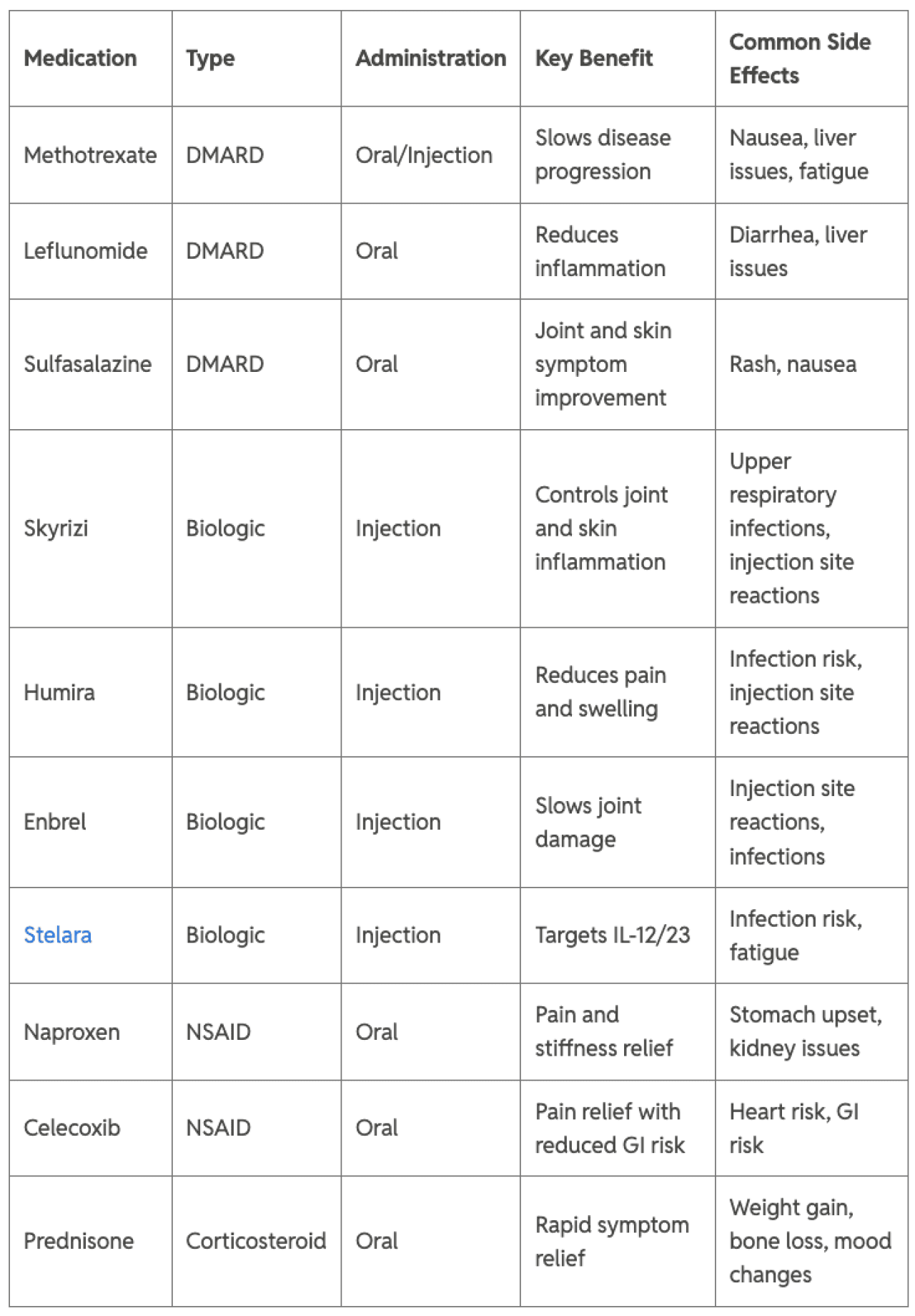
Psoriatic Arthritis Medication Comparison


A table listing psoriatic arthritis medications and their type, administration, benefits, and common side effects.

SaveHealth

Otezla PDE-4 inhibitor Oral Significant joint relief Nausea, decreased in 16 weeks appetite, weight loss, anxiety, insomnia.

Common Side Effects of Psoriatic Arthritis Medications


Side effects vary depending on the type of medication and individual response.

DMARDs

Biologics

  • Increased risk of infections
  • Injection site reactions
  • Upper respiratory infections

NSAIDs

  • Stomach upset
  • Kidney issues
  • Increased bleeding risk

Corticosteroids

PDE-4 inhibitors

  • Gi side effects (Nausea, diarrhea, decreased appetite, abdominal pain, weight loss)
  • Headache, dizziness, insomnia, anxiety, nervousness
  • Infections (upper respiratory infections)

Choosing A Psoriatic Arthritis Medication


Selecting the appropriate psoriatic arthritis medication requires balancing effectiveness, side effect tolerance, convenience, and cost.

Factors to consider:

  • Severity of joint and skin symptoms
  • Past medication response
  • Risk of side effects
  • Administration preference (oral vs injection)
  • Insurance coverage and out-of-pocket cost

Tips for Managing Psoriatic Arthritis Medication Costs


Psoriatic arthritis medications, particularly biologics and DMARDs, can be costly. Patients can reduce expenses by:

  • Comparing pharmacy prices
  • Considering generic options for DMARDs
  • Exploring manufacturer savings programs
  • Reviewing insurance co-pay assistance
  • Planning prescriptions to avoid gaps in therapy

Even small monthly savings can make a significant difference for long-term disease management.

Psoriatic Arthritis Medications & Prescriptions


Psoriatic arthritis management involves a range of medications, including DMARDs, biologics, NSAIDs, and corticosteroids. Understanding options like Methotrexate, Leflunomide, Sulfasalazine, Skyrizi, Humira, Enbrel, Stelara, Naproxen, Celecoxib, and Prednisone helps patients select effective therapies for their condition. Working closely with a healthcare provider while considering effectiveness, safety, and affordability can optimize long-term outcomes.

https://krdo.com/stacker-science/2025/12/31/psoriatic-arthritis-medications-a-comprehensive-guide/#google_vignette 

Tuesday, 14 October 2025

Beyond The Joints: How Arthritis Affects The Whole Body And How Modern Treatments Are Changing Lives

From news18.com/lifestyle

Arthritis affects far more than joints from heart health to emotional well-being but modern treatments and holistic care are helping patients regain active, fulfilling lives

When most people think of arthritis, they imagine stiff, painful joints, knees that ache or hands that no longer move as freely. Yet, as medical experts emphasize, arthritis extends far beyond the joints. It’s a complex, systemic condition that can affect nearly every aspect of a person’s physical and emotional well-being.

“When patients come to me with arthritis, they usually focus on their painful knees. But what they don’t realize is that arthritis affects their entire body and life," says Dr Deepak Saini, Senior Consultant and Joint Replacement Surgeon, Shalby Hospital, Jaipur. “The constant inflammation can increase their risk of heart problems, we’re seeing more arthritis patients developing cardiovascular issues."

This connection between chronic inflammation and heart health has gained increasing attention. Studies suggest that inflammatory chemicals involved in arthritis may contribute to the build-up of arterial plaque, heightening the risk of cardiovascular disease.

Beyond the physical, arthritis also exerts a heavy emotional and social toll. “Many of my patients experience exhaustion that never goes away, no matter how much they rest," adds Dr Saini. “Depression is another major issue because pain limits what they can do. They start avoiding social gatherings and family functions."

As mobility decreases, another vicious cycle begins: reduced movement leads to weight gain, which further increases pressure on already damaged joints. “It’s a domino effect," he explains. “But the important message is that arthritis is manageable if we treat it holistically. From medications to lifestyle changes, and in advanced cases, modern surgical interventions with state-of-the-art implant technology, we have effective ways to stop this progression and help patients reclaim their active lives."

                                                Arthritis can be managed with medications, physiotherapy, and lifestyle changes. (Image: AI)

Arthritis: More Than Pain, It’s a Life-Altering Condition

“People think arthritis is just about joint pain, but I see how it devastates every aspect of my patients’ lives," agrees Dr. Ashwani Maichand, Director, Orthopaedics, CK Birla Hospital, Punjabi Bagh, Delhi. “A 55-year-old who loved playing with his grandchildren suddenly can’t get on the floor. A working professional starts missing days at work because fatigue is overwhelming. And what’s worse is isolation. They stop going out, stop exercising, and their overall health declines."

Dr. Maichand emphasizes that the consequences of arthritis go well beyond mobility issues. “When movement becomes painful, people begin withdrawing not only from physical activity but also from social life," he says. “That isolation and inactivity worsen mental health and can accelerate other chronic conditions like diabetes, hypertension, and obesity."

Modern Medicine Offers Hope

Despite these challenges, both experts highlight a powerful message: the story doesn’t have to end in limitation.

“We’re in an era of remarkable medical advancement," says Dr. Maichand. “Whether it’s targeted therapies for early-stage arthritis or robotics-assisted joint replacement procedures, we can intervene effectively. I’ve seen countless patients return to activities they thought were gone forever."

Early diagnosis is critical, he adds, because intervention at the right stage can prevent cascading complications. “Early diagnosis and the right treatment plan make all the difference in preventing these effects," he stresses.

Dr. Saini echoes this sentiment. “We now approach arthritis not just as a joint problem but as a whole-body condition. By integrating lifestyle modifications, nutrition, medication, physiotherapy, and advanced surgical options, we can give patients both mobility and quality of life."

A Holistic Approach to Healing

Both doctors underscore that managing arthritis effectively requires a multidisciplinary approach addressing inflammation, mental health, physical function, and social well-being.

“Arthritis care has evolved from simply treating pain to restoring life," says Dr. Saini. “It’s about helping patients move without fear, sleep without pain, and live without constant fatigue."

As awareness grows and access to modern medical technologies expands, patients no longer have to accept a life of limitation. With early detection, expert care, and a holistic treatment plan, arthritis can be managed, mobility restored, and life reclaimed one step at a time.

https://www.news18.com/lifestyle/health-and-fitness/beyond-the-joints-how-arthritis-impacts-the-whole-body-and-the-promise-of-modern-treatment-9632403.html 

Friday, 8 August 2025

"I was diagnosed with rheumatoid arthritis 20 years ago - here's how I manage it"

From hellomagazine.com

Fitness instructor Tara Riley has a tried and tested method

I was 27 when I was diagnosed with rheumatoid arthritis (RA).

It started with a sore knuckle, and I didn't think much of it, but then the same knuckle on the other hand was also sore.

Then it was another knuckle and again on the other hand - that's when it hit me, it could be RA as it is often symmetrical, affecting the same joints on both sides of the body. I sought a diagnosis from a rheumatologist and tested positive for the RA factor.

I wasn't keen to start on medications at that time as I was so young - I worried about side effects and that I would be on these medications for the rest of my life, and fretted that my body could become so used to the meds that they would stop working by the time I was 50.

My daily life

I'm now 49, and honestly, arthritis doesn't stop me from doing anything. I do wake up with achiness or stiffness in some joints daily, but at 49 years old, who doesn't?

My RA doesn't stop me primarily because I won't let it. It is often painful, but as soon as I start moving gently and working into the mobility of the joints, the stiffness eases and everything feels better. The fact that it's not a huge impact on my life is 100 per cent down to me making it non-negotiable to keep moving.

Managing arthritis

There are three key factors that help me manage my RA today as a 49-year-old woman - though for 20 years, I managed my RA through just two factors —exercise and diet alone.

1. Movement

I believe the most important overall element and the one that's helped me for more than two decades is movement.

I exercise most days because I teach barre most days, as well as doing my own workouts as needed based on how I feel.

woman in a complicated yoga pose © Cecilia Cristolovean-Csiky
Movement helps Tara manage her arthritis

The variety of exercise I do is where I believe the sweet spot is. I need to move in ways that are going to work to ease sticky joints, strengthen bones and muscles, maintain or improve mobility (this is a big one because the mobility of a joint is exactly what RA is going to affect) and also improve endurance, cardiovascular health, balance, and control.

I started moving this way because it was what my body needed, it's how I felt better and it’s also helped me cope mentally with chronic pain, and it's now widely known how good barre is for your joints because it combines high repetitions under a safe load. Movement and specifically the types of exercise I do have maintained my strength and mobility more than any other factor, without a doubt. 

2. Diet

The second key element that helps me manage my RA is through diet. For years, I was gluten-free, based on a sensitivity that came up when I was first tested, but as I've grown and changed and moved to the UK and had children, my body has changed too. 

I saw a wonderful Ayurvedic doctor here in the UK for a few years. I learned so much working with her. Without going down an Ayurvedic Dosha rabbit hole — the very condensed Ayurvedic take on my RA was that I had too much fire in my body. Too much unbalanced fire can cause heat, pain and inflammation in the joints. So, I followed an Ayurvedic diet as well as taking herbal supplements to help balance the fire. This worked well but it definitely took a lot of dedication to adhere to dietary suggestions and herbal supplements that went with.

Perhaps my biggest takeaway was that I discovered what foods did and didn't affect my joints and this has massively shaped my diet today. I’ve become incredibly in-tune with what does and doesn’t work for me. And what works for me, won't necessarily work for someone else, but I do avoid at all costs all dairy, eggs and fried and processed foods and I have a good understanding of what other foods, sauces, dressings etc will affect me. 

3. Medication

Thirdly, I am now on medication for RA but only made this decision to start medication last year.

I had managed well up until then, but flares were getting harder to come out of and my usual tricks didn't seem to be working. Perhaps because I'm in perimenopause and hormones could be affecting it, I'm not sure, but I was at the point where I do have damage in some joints and I didn’t want things to continue to slide that way. With an autoimmune disease, it’s not just going to go away and it will continue to affect my joints, which are my livelihood.

woman sitting on the floor with a pilates ball© Cecilia Cristolovean-Csiky
Tara has had arthritis since she was 27

The medication I am taking is a DMARD, which is a disease-modifying antirheumatic drug and works by suppressing the immune system and reducing inflammation, thereby slowing the progression of RA and potentially preventing joint damage.

This category of medication is different from your typical ibuprofen, which might relieve symptoms of pain and inflammation, as DMARDs aim to modify the underlying disease process. 

I am on a very low dose and the hope is to possibly, in time, if it’s believed the disease is 'inactive,' we might be able to reduce rather than up my dosage. I wouldn’t expect that to happen without me continuing the other things I do to keep my body as mobile, strong and operating well as I can alongside.

 The medication is part of what helps me manage but honestly, a potentially bigger one is maintaining my physical strength and mobility as well as my mental health to keep things moving in the right direction. I will continue to move my body daily and right now the medication helps me do that.

4. Supplements

I love a supplement. I've taken turmeric (to help reduce inflammation) and a good probiotic (because the gut is related to everything!) for many years and have added in magnesium (great for bone and muscle health and sleep!) and Ashwaganda more recently and I believe all of these supplements are part of what helps support my overall health wellbeing.

Tara is founder of the Tara Riley Method which fuses Pilates, barre, strength training and cardio. Tara teaches via her on-demand platform and in person at her SE London studio.

https://www.hellomagazine.com/healthandbeauty/health-and-fitness/848226/diagnosed-rheumatoid-arthritis-20-years-how-manage-it/