Saturday, 20 December 2025

Lesser-Known Remedy For Ankle Arthritis

From miragenews.com

Patient pain-free and mobile again after total ankle replacement by UConn Health's Dr. Lauren Geaney
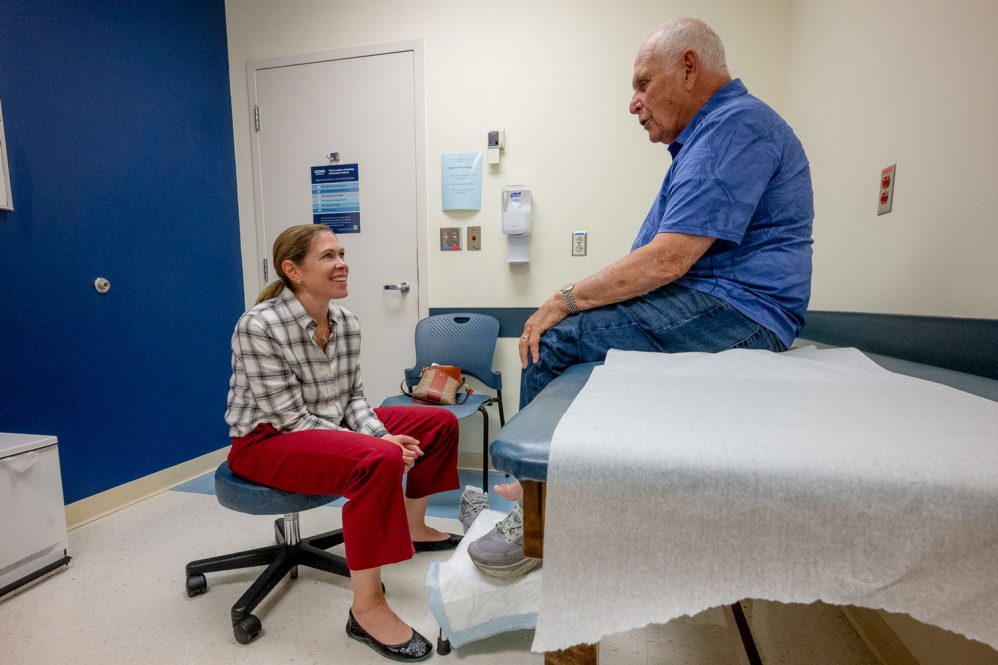
physician and patient talking in exam room

Dr. Lauren Geaney, UConn Health foot and ankle surgeon, sees Joe Marinello for a follow-up appointment six months after performing a total ankle replacement on his right foot. (Tina Encarnacion/ UConn Health photo)

A somewhat uncommon procedure is proving to be an effective solution for problems associated with ankle arthritis.

When pain becomes persistent and mobility becomes limited, an ankle fusion will address the pain. But some patients are candidates for an ankle replacement, which comes with added benefits.

"It allows patients to maintain their range of motion, and gait is better with the ankle replacement," says Dr. Lauren Geaney, UConn Health foot and ankle surgeon. "But a lot of people aren't aware total ankle replacement exists as a really great option to help pain and restore function in patients suffering from ankle arthritis."

At this time last year, Joe Marinello, of Wethersfield, was struggling with pain in his right ankle that had progressed to the point where he had a bad limp and was using a cane.

"I had pain most of the time when I moved, so my mobility was very limited, and I just didn't do a lot of things," Marinello says. "I took a lot of ibuprofen and whatever to deal with the pain, and a lot of the pressure of doing things, like shopping and doing other stuff, was put on my wife."

Marinello, 86, says the problem went back to a bad day on the baseball field in 1961, when he was playing third base for Marietta (Ohio) College.

"I slid into home and my bottom spike caught home plate, flipped me over," he says. "I busted my ankle, and actually the foot was 90 degrees and the tibia bone was on top."

He says a doctor at a bone clinic in Parkersburg, West Virgina, reset the bones in his foot without surgery.

"He had to set it at a certain angle so that everything stayed together," Marinello says. "It was a little crooked at first, but through therapy, the muscles straightened out. I broke it in May, and went into the service in September. And instead of me doing all the marching, I had to do the running, but then I went to the infirmary, and by February I was playing baseball for the squadron."

Being an athlete his whole life, it took until about 10 years ago for the decades of running to finally take their toll. He started seeing Geaney, who started him on cortisone shots. They would provide about three months of relief, but as the years went by, they lost their effectiveness.

"Ankle arthritis is much less common than hip and knee arthritis, and ankle replacement is a newer procedure," Geaney says. "The technology and our knowledge of ankle replacements even in the last 10 years since I've been in practice has grown exponentially. When I first started, I was doing about one a year, primarily because we didn't know as much about who did well. Now I'm doing about one a month or so."

Initially concerned about downtime and recovery, Marinello came around on the idea of ankle replacement surgery.

For the first 11 days after the surgery on March 20, his foot was in a splint and he was under doctor's orders to not put any weight on it. He went back to get the stitches removed and graduated to a walking boot with limited weight bearing.

"I could put it down, but I had to put pressure around my walker, I had to stay with the walker," Marinello says. "Then on April 28, she looked at it, and said, 'Put your shoe on.'

"I have had no pain since she did the surgery. I had swelling from the surgery, but I had no pain. It was incredible."

"I think he had an excellent outcome," Geaney says. "This is a great surgery to restore patients to low-impact activity like walking, hiking, biking, or swimming."

That is, after staying off the repaired foot for a few weeks, followed by rehabilitation. Geaney says it can take up to a year for full recovery.

Marinello's course of physical and occupational therapy lasted four months, at which point he reported, "The only thing she doesn't want me to do is run, and I haven't run in years, and she doesn't want me to climb a ladder. Other than that, I get my boat, I go fishing, I shop with my wife now, I help her, I carry stuff. I'm living pretty much a normal life based on my age. But to this day, I can't believe I'm walking with no pain. I'm mobile. I walk straight. There's no limp and there's no pain."

And he developed quite a fondness for his surgeon.

"To me she walks on water, because she's got me walking with no pain," Marinello says. "I talk to her like I'm talking to a friend. She's so personable and down to earth, it's incredible."

https://www.miragenews.com/lesser-known-remedy-for-ankle-arthritis-1593981/


Thursday, 18 December 2025

Managing Your Aches and Pains in the Winter

From u.osu.edu

Anyone with aches & pains knows that cold weather makes everything hurt a little more, and makes it harder to work and get everything done. According to Professor Robert H Shmerling, MD, at the Harvard Medical School, weather may or may not have an impact on your arthritis pain, but there may be “a connection between weather and joint symptoms… researchers have been unable to figure out just what matters most about the weather and arthritis symptoms or why there should be a connection”. 

While you cannot control the weather, you can control how to react to it, and how to manage your health, wellness and productivity.

If you will be working outside in cold weather:

  • Wear layers of clothing, keep an extra pair of gloves with you (in case one pair gets wet)
  • Wear a hat that covers your head and ears, and use the hood on your coat or sweatshirt to keep out drafts
  • Take short, frequent breaks to warm up, and don’t overexert – yourself, energy is required to keep muscles warm
  • If you are working in remote areas, try to work with someone else, and carry your cell phone in case you need to call for help

The Arthritis Foundation of Washington reports “a lack of physical activity will cause joints to become stiff. Exercise eases arthritis pain. It increases strength and flexibility, reduces joint pain, and helps combat fatigue”.

Stay active and healthy over the winter:

  • Include stretching, strengthening and endurance activities in your daily routine
  • Plan your day to alternate between difficult and easier tasks, do the most strenuous tasks early, when you have the most energy
  •  Sit when possible to minimize stress on your joints
  •  Be mindful of proper techniques for lifting, carrying, bending and reaching overhead
  • Use labour saving devices when possible
  • Transport items by cart rather than carrying them

Tuesday, 16 December 2025

Why Arthritis Is Fast Emerging As A Disease Of The Young In India

From news18.com

Once seen as an age-related condition, arthritis is now affecting young Indians. Experts explain the lifestyle, obesity, and nutrition factors driving early-onset arthritis

For decades, arthritis was widely perceived as an inevitable part of ageing, something that crept in with advancing years, bringing along joint pain, stiffness, and reduced mobility. But that perception is rapidly changing in India. Doctors across the country are now seeing a worrying rise in arthritis cases among people in their 20s, 30s, and 40s, signalling a significant shift in the nation’s disease burden.

Dr Ashraf Khan, Consultant Orthopaedic and Joint Replacement Surgeon, Ruby Hall Clinic, Wanowrie, believes this trend is closely tied to how modern lifestyles have evolved. “Arthritis has long been associated with older adults, but today, we are diagnosing it in individuals as young as their 20s and 30s. This is an ominous change," he says.

One of the biggest contributors is a sedentary way of life. Long hours spent sitting at desks, excessive screen time, and minimal physical activity weaken the muscles that are meant to support the joints. When muscles fail to absorb everyday stress, the burden shifts directly onto the joints. Over time, even routine activities such as walking, climbing stairs, or standing for long periods accelerate joint wear and inflammation, paving the way for early-onset arthritis.

Dr Vijay Shetty, Director, Orthopaedic and Joint Replacement, Dr L H Hiranandani Hospital, Powai, echoes this concern, noting that he has seen a marked rise in young patients aged 25–45 presenting with early arthritis, particularly in the knees and hips. “Prolonged sitting, reduced activity, and poor muscle conditioning overload the cartilage and hasten degeneration," he explains.


Compounding the problem is India’s growing obesity epidemic among young adults. Excess body weight places disproportionate stress on weight-bearing joints such as the knees and hips. Dr Khan points out that even modest weight gain can significantly accelerate cartilage damage. Diets rich in processed foods, refined sugars, and unhealthy fats further worsen the issue by increasing low-grade inflammation throughout the body, which in turn aggravates joint degeneration.

Dr Shetty adds that obesity often overlaps with metabolic syndrome, intensifying chronic inflammation and speeding up cartilage breakdown. At the same time, he highlights another modern paradox: while many young people are inactive, others are engaging in high-intensity fitness routines without proper conditioning or technique. “Untreated ligament injuries, meniscal tears, and cartilage damage from sports or workouts can accelerate post-traumatic arthritis in young adults," he says.

Nutritional deficiencies are another silent driver. Both specialists underline the widespread lack of vitamin D, calcium, and protein among young Indians, largely due to indoor lifestyles and limited sun exposure. These nutrients are vital for bone strength, muscle function, and cartilage repair. Deficiencies weaken the musculoskeletal system, making joints more vulnerable to early degeneration and pain.

Beyond lifestyle and nutrition, other factors are also at play. Dr Shetty notes that genetic predisposition, autoimmune conditions like early-onset rheumatoid arthritis, smoking, and even post-COVID complications are contributing to the rise. “Post-COVID, we are seeing a sharp increase in avascular necrosis of the hip, which often progresses to hip arthritis at a young age," he explains.

The consequences of arthritis in younger adults extend far beyond physical discomfort. Dr Khan warns that early arthritis can lead to reduced mobility, chronic pain, emotional stress, and long-term dependence on medication significantly affecting productivity and quality of life during the most active years. In severe cases, it may even result in joint replacement surgeries much earlier than previously seen.

Despite the growing concern, both experts stress that arthritis in the young is largely preventable. Early identification, timely medical consultation for persistent joint pain, and proactive lifestyle changes are critical. Strength training to support joints, maintaining a healthy weight, balanced nutrition, ergonomic workspaces, and proper rehabilitation after injuries can all delay or even prevent the progression of the disease.

“Arthritis in the young is no longer rare," Dr Shetty concludes, “but with awareness, early diagnosis, and lifestyle modification, it is a trend we can still reverse."

As India grapples with changing lifestyles and health habits, arthritis has clearly ceased to be just a disease of old age. Preventive care today may be the key to protecting joint health for decades to come.

https://www.news18.com/lifestyle/health-and-fitness/why-arthritis-is-fast-emerging-as-a-disease-of-the-young-in-india-9771216.html 

Monday, 15 December 2025

According to Scientists, This Brazilian Plant Could Help Treat Arthritis

From scitechdaily.com

Alternanthera littoralis, commonly called Joseph’s Coat, is native to Brazil’s coastal regions and has a long history of use in treating microbial infections and parasitic diseases.

Scientists in Brazil from the Federal University of Grande Dourados (UFGD), the State University of Campinas (UNICAMP), and São Paulo State University (UNESP) have carried out new research on the Joseph’s Coat plant (Alternanthera littoralis), demonstrating its safety along with anti-inflammatory, pain-relieving, and anti-arthritic effects.

The plant grows naturally along Brazil’s coastline and has a long history of use in traditional remedies for inflammation, infections caused by microorganisms, and parasitic illnesses. Until recently, however, these traditional uses had not been thoroughly supported by pharmacological studies or formal safety evaluations.

As reported in the Journal of Ethnopharmacology, the research began with a detailed chemical analysis of the plant. The goal was to determine which bioactive substances are present in the ethanolic extract obtained from its aerial parts. This stage of the work was led by Marcos Salvador, a pharmacist at the Institute of Biology (IB) at UNICAMP. In the next phase, a research group headed by pharmacologist Cândida Kassuya from the Faculty of Health Sciences at UFGD tested the extract in experimental models of arthritis to assess its anti-inflammatory effects.

“Finally, we performed the toxicological analyses under my coordination,” explains Arielle Cristina Arena, associate professor in the Department of Structural and Functional Biology at the Institute of Biosciences at UNESP’s Botucatu Campus.

Brazilian researchers have scientifically examined a coastal plant long used in traditional medicine, uncovering evidence of anti-inflammatory and pain-relieving effects in preclinical models. The findings suggest both biological activity and a favourable safety profile. Credit: Shutterstock

Anti-Inflammatory Effects and Safety Findings

The results showed that the ethanolic extract of A. littoralis significantly reduces inflammation in laboratory animals. “In the experimental models, we observed reduced edema, improved joint parameters, and modulation of inflammatory mediators, suggesting antioxidant and tissue-protective actions,” says Arena.

According to the professor, the findings reinforce the plant’s medicinal potential and establish a solid scientific basis for future preclinical research and the possible development of herbal products. The conclusions suggest a safety profile at therapeutic doses that may also be promising for human use.

Limitations, Next Steps, and Broader Impact

Despite the encouraging outcome, it is not yet possible to recommend its immediate clinical use. Further toxicological analyses, as well as clinical studies and the standardization of the extract, are needed to ensure safety, efficacy, and pharmacotechnical quality. Additionally, the path to therapeutic application requires further regulatory steps.

“This research is part of an ongoing line of investigation developed by UFGD, UNESP, and UNICAMP, and our purpose is to value Brazilian biodiversity and traditional knowledge, but with a rigorous scientific basis, promoting the safe and rational use of natural products,” says Arena.

https://scitechdaily.com/according-to-scientists-this-brazilian-plant-could-help-treat-arthritis/ 

Tuesday, 9 December 2025

Your guide to preventing psoriatic arthritis flare-ups, from medication and symptom tracking to lifestyle changes

From mcpress.mayoclinic.org 

Living with psoriatic arthritis (PsA) can be frustrating. On top of causing psoriasis — a condition that causes thick, scaly patches to form on the skin — PsA also has classic arthritis symptoms such as joint stiffness, pain and swelling.

“Psoriatic arthritis can present in different ways and affect any joint, including small joints like the hands or feet and, rarely, bigger joints like the knees and shoulders and even the spine,” explains Delamo I. Bekele, M.B.B.S., a clinical rheumatologist and inflammatory arthritis specialist at Mayo Clinic in Rochester, Minnesota.

And just like symptoms of psoriasis, PsA symptoms are often cyclic, meaning they flare up and then calm down. At times, flare-ups may only cause mild joint discomfort. But other times, the pain, swelling and stiffness may be so severe that you have trouble working, moving and completing your daily tasks.

PsA can get worse over time, especially in people who have multiple joints affected, have joint damage or have PsA that doesn’t respond to treatment. Understanding and treating flare-ups — and how to prevent them — can help you protect against joint damage, keep you as mobile as possible and minimize the impact PsA has on your quality of life.

                                                                                                                      Getty Images

What is a PsA flare-up?

With PsA, a flare-up does not necessarily involve skin symptoms, though for some people it does. Most of the time, “a flare-up means an acute worsening of joint pain, stiffness and swelling in someone who usually has chronic psoriatic arthritis,” explains Dr. Bekele. “This can range from one joint to multiple joints and tendons,” he says.

The length and intensity of a flare-up depends on the person. For some, a flare may be intense and last several weeks, while for others, a flare causes only mild symptoms that linger for a day or two. During a flare, you may notice that a new joint or area of the body is affected.

In rare situations, Dr. Bekele says a flare may involve dactylitis — swelling of the fingers or toes. Dactylitis can give a sausage-like appearance to the fingers and toes. As a result, you may hear this type of inflammation called sausage digits.

While flare-ups can’t always be prevented, there are a few tell-tale signs that can help you predict the onset and severity of a flare-up, including:

  • Morning stiffness that lasts more than an hour.
  • Visible swelling of joints or tendons.
  • Reduced range of motion.
  • Pain or tenderness in the joints or tendons.

What to know about preventing PsA flare-ups

PsA is a chronic, lifelong condition. Currently, there aren’t treatments that can cure PsA or completely prevent flare-ups. But there are a number of treatment options that can help protect your joints, manage symptoms and improve your quality of life.

The most effective way to prevent flare-ups is with medication — and the sooner therapy is started, the better protected your joints will be. A range of medications is available for PsA and, depending on the situation, your care team may recommend a pill, an injection or an infusion. Topical medications also can help with your skin symptoms, though you may need to see a dermatologist to get these treatments to apply to your skin.

Your medication options may include:

  • Nonsteroidal anti-inflammatory drugs (NSAIDs), which help reduce pain and swelling during a flare. These medicines include ibuprofen (Advil, Motrin IB, others) and naproxen sodium (Aleve), which you can buy without a prescription..
  • Conventional disease-modifying antirheumatic drugs (DMARDs), which help prevent joint damage and control joint inflammation by targeting the immune system broadly.
  • Biologic DMARDs, which target specific parts of the immune system to control joint and skin inflammation and prevent joint damage. Typically, Dr. Bekele says biologics are used if conventional DMARDs aren’t effective.
  • Targeted synthetic DMARDs, which may be prescribed if conventional DMARDs and biologic agents aren’t options or aren’t tolerated. These medicines include Janus kinase (JAK) inhibitors.

Although finding the right PsA medication can take time, Dr. Bekele says the goal is to achieve remission — a time when your PsA is either inactive or minimally active. “We know there’s clear data for people who are in remission that the risk of flare-ups is extremely low, if non-existent,” Dr. Bekele says. Taking medications consistently as prescribed is very important to achieving remission.

In addition to prescribing medications, your care team will likely discuss other lifestyle modifications that can help you prevent flares. You may be told to:

  • Minimise stress. Too much stress can trigger an inflammatory response from the immune system, which can make your pain, swelling and skin symptoms worse.
  • Quit smoking. As with many other chronic conditions, smoking can make your symptoms worse.
  • Maintain a healthy weight. Excess weight can increase production of certain proteins called cytokines that exacerbate PsA symptoms. Also, too much extra weight can make some PsA medications less effective. Working on weight loss can help improve your PsA symptoms and overall health.
  • Improve your sleep hygiene. Sleeping can help reduce stress levels and support your overall health.
  • Maintain a PsA-friendly diet. Anti-inflammatory diets, such as diets that follow principles similar to those of the Mediterranean diet, can help you manage your symptoms.
  • Exercise regularly. Dr. Bekele recommends low-impact activities such as walking and pool-based therapy to keep your joints mobile.

Tracking your flare-ups can help you and your care team identify what seems to worsen your PsA symptoms. Triggers can range from certain foods, such as gluten, to changes in the weather. To get started, consider using the, online psoriatic disease flare guide and symptom tracker, a free product offered by the National Psoriasis Foundation.


What to do for a flare-up

Sometimes — despite your best efforts — flares happen. To best cope with a flare-up, work with your healthcare professional to develop a care plan ahead of time.

For the first step, Dr. Bekele recommends assessing the severity of your symptoms — such as pain level, stiffness and swelling — as soon as you notice them. If you have severe pain, have trouble walking or are unable to perform your typical tasks, call your care team immediately or seek emergency care.

In some situations, your care team may recommend steroid injections. But Dr. Bekele says steroids are used sparingly, as they can worsen joint and cartilage health in the long run and may cause unwanted side effects, such as weight gain or worsening skin symptoms.

If your flare is minimal to mild, Dr. Bekele says you may consider using non-prescription anti-inflammatory medicines, such as ibuprofen and naproxen sodium. Ice, rest and, if possible, time off work also can help you manage your flare symptoms.

https://mcpress.mayoclinic.org/psoriatic-arthritis/your-guide-to-preventing-psoriatic-arthritis-flare-ups-from-medication-and-symptom-tracking-to-lifestyle-changes/ 

Tuesday, 2 December 2025

How Do You Manage Holiday Stress With Psoriatic Arthritis?

From healthcentral.com

By Meaghan Quirin

It starts with setting realistic expectations for the season 

For me, managing holiday stress with psoriatic arthritis (PsA) really comes down to protecting my energy: physically, emotionally, and socially. The holidays can be so joyous, but they can also be exhausting. Between navigating endless to-do lists, family dynamics, colder weather, travel, and packed calendars, it’s a time of year that can push my body and nervous system past their limits pretty quickly if I’m not intentional about how I move through it.

I’ve learned to start by setting realistic expectations. I used to say yes to everything, every invitation, every tradition, every last-minute errand because I didn’t want to let people down or miss out. But now I’m much more honest with myself about what I actually have the capacity for. I ask: What matters most to me this season? What can I let go of? That alone takes so much pressure off.

I also try my best to plan ahead in ways that reduce the chaos. I spread things out over a few weeks instead of cramming errands and prep into one weekend. I look at what else is on my calendar before committing to anything new, and I make sure to block off time for rest, especially if I know something will require more energy or recovery, like travel or a family gathering.

Comfort is another big part of how I get through the season. I’ve let go of trying to look perfectly put together in ways that don’t actually feel good. These days, I’m prioritizing warm layers, soft clothes, supportive shoes and whatever else helps me stay grounded and comfortable in my body. If that means showing up to the holiday party in sneakers and carrying heat packs in my bag, so be it.

Emotionally, I try to give myself space to feel whatever’s coming up. The holidays can stir up grief and frustration of not being able to participate the way I want to. I don’t force myself to be cheerful if I’m not feeling it. But I also try to stay open to small moments of joy and connection, even if they don’t look like I envisioned. Some years, that means new traditions, or quieter ones; it’s saying no to protect my peace and not feeling bad about it.

More than anything, I remind myself that I don’t need to earn rest or prove anything to anyone. Living with PsA means I already have to be mindful of how I use my energy all year long, but during the holidays, I double down on that to avoid stress and burnout. It’s not about doing everything. It’s about doing what matters, in a way that is mindful of how I feel!

https://www.healthcentral.com/condition/psoriatic-arthritis/how-do-you-manage-holiday-stress-with-psa?ap=nl2060&rhid=67ec2b8321f52bf01b0cca01&mui=&lid=141093361&mkt_tok=NTQxLUdLWi0yNDMAAAGefpBusLjyFe7YrljxI-BfpeWftzUtbI_jKvnM0nxzjSfnV3VgdM7Tkf7nAbudJms7BQwBBuxBEDGU80WbLuOnSkx_d4YCS9xdvxfenoZG2k-xeW4