Friday, 11 August 2023

8 ways to keep your knees healthy

From restless.co.uk

The knees are the largest joint in the body and we rely on them for pretty much any form of movement – such as when walking, running, jumping, and climbing. This means that – alongside other factors like ageing, injury, weight gain, genetics, and osteoarthritis – it’s not unusual for knees to undergo a certain amount of wear and tear over the years.

While knee pain and stiffness can become more common as we age, it doesn’t have to be inevitable – and the good news is that there are things you can do to help keep your knees as healthy as possible.

Here, we’ll be covering eight ways to protect and care for your knees, which we hope you’ll find useful.

How do our knees change with age?

How do our knees change with age

With each step we take, our knees fight against gravity and absorb pressure. People of any age can experience knee pain, but mature adults are generally more at risk.

This is because knee cartilage gradually breaks down over time, which can make muscles and ligaments weaker. Together, these factors can increase the risk of knee injury, pain, and/or swelling.

What other factors can affect knee health?

What other factors can affect knee health

As well as ageing, there are a number of other factors that can impact our knee health.

This includes genetics, activity level, and previous knee injuries like bursitis, tendinitis, and fractures. Even if an injury occurred a long time ago, damage to the bones, joints, muscles, and ligaments can remain.

Some of the most common knee problems and symptoms include pain, swelling, redness, stiffness, weakness, popping or crunching sounds with movement, and an inability to fully straighten the knee.

According to the NHS, a type of knee pain called patellofemoral pain syndrome (also known as runner’s knee) is one of the most common conditions. It occurs when the knee cap rubs against the thigh bone during movement – and is thought to affect around a quarter of all adults at some stage. It’s usually caused by overuse of the leg.

Knee pain can also be an issue for those with osteoarthritis because the condition is associated with deterioration of the cartilage in the knee joint.

8 ways to keep your knees healthy

ways to keep your knees healthy

So now we know some of the most common causes and types of knee problems, what can you do to boost your knee health?

We’ll cover some ideas below…

1. Maintain a healthy weight

Being overweight increases the load and, therefore, the pressure placed on our knees. Not only can this add stress to the joint, but it also has the potential to speed up the breakdown of cartilage.

In fact, research estimates that a force of nearly three to six times a person’s body weight is placed on the knee while walking. This means that being only 4.5kg overweight can increase pressure on the knee by between 13-27kg each step.

According to experts, this makes overweight women nearly four times more likely to develop knee osteoarthritis, and overweight men five times more likely.

If you’re looking to lose weight in a healthy way, you’ll find plenty of tips in the diet and nutrition section of our website. This includes guides on popular diets like the DASH, volumetrics, and Mediterranean diets, and articles such as 10 tips for healthy eating out and 15 quick and easy diet swaps for a healthier lifestyle.

2. Add some low-impact exercise to your routine

It can be tempting to avoid exercising if you’re struggling with knee pain. But research has shown that this can be counterproductive.

Studies have found that certain types of exercise are beneficial for maintaining healthy joint function, reducing knee pain, and improving strength and range of motion in the knees.

Low-impact exercises are a good option for anyone wanting to stay active without putting too much pressure on their joints.

Some examples of low-impact exercise include rowing, swimmingyogaPilates, and walking netball or football. For more ideas, check out our articles; 15 low-impact exercises and 7 low-impact exercises you can do at home.

3. Work on strengthening the muscles around your knees

Strengthening the muscles that surround your knee joint can be extremely beneficial for knee health.

This is because having stronger muscles reduces the amount of pressure and strain placed on the knees. Ultimately, the stronger your legs are, the more they can help to cushion your knees during movement.

Some of the most beneficial areas to work on your strength for knee health include the outer, middle, and inner thigh muscles – and resistance training is a useful way to do so.

You can build strength both at home or in the gym – and with minimal equipment. For more information on how to get started, check out our article, The importance of building strength and balance in your 50s and 60s, or have a read of our guide to joining the gym.

4. Improve your posture

Having good posture is all about having your spine in neutral alignment. When your spine’s in alignment, the rest of your body follows.

Good posture puts us in a better position to improve flexibility and build strength and balance – all of which can have a significant impact on the amount of stress placed on joints. Research has also found that good posture is important for keeping joints lubricated, which helps to prevent stiffness and pain.

If you’d like to get started, why not give some of these 5 exercises to help improve your posture a go?

5. Eat a joint-friendly diet

Diet can be a powerful tool when it comes to knee health.

Various nutrients – including vitamins ACD, and Kcalcium, and omega-3 fatty acids – have been found to be particularly beneficial for joints. Examples of foods that are rich in these nutrients include fatty fish, walnuts, ginger, broccoli, spinach, and olive oil.

For example, studies have shown that broccoli’s vitamin C content is also important for protecting and creating cartilage – which is essential for allowing bones to glide over one another smoothly.

Research has also revealed that people who eat higher amounts of omega-3 fatty acids are less likely to develop rheumatoid arthritis – a condition that commonly affects the knees on both sides.

Meanwhile, alcohol, added sugars, red meat, refined carbohydrates, and processed, fried, or high-fat foods have all been found to have a negative effect on knee health. For example, studies have found that eating too much processed and red meat can increase inflammation in joints and cause pain and stiffness.

For more information on how to tailor your diet to boost knee health, check out our article; 10 best foods for healthy joints and which to avoid.

6. Stretch regularly

Very few of us take the time to stretch regularly until we’re already in pain. But there are many benefits to making stretching part of your daily routine.

Stretching the muscles that support your knees helps to improve mobility across the entire joint. According to research, stretching can improve overall knee health and help prevent common types of knee pain from developing.

Experts recommend focusing on stretching your quadriceps, hamstrings, hips, glutes, and core. For tips and ideas on how to add stretching to your routine, Very Well Fit has a useful list of 10 essential stretches for the knee. 

Note: Many people assume it’s best to stretch before exercising, but it’s important to warm up slowly first. This will help to increase blood flow to the muscles and reduce the risk of injury.

7. Invest in the right shoes

Wearing shoes that are flimsy and unsupportive can put unnecessary strain on your knees.

Running and athletic shoes designed to provide joints with cushioning and support and keep your feet in alignment are generally good options for knee health. However, there are several things to look out for, as recent research has suggested that not all specialist sports shoes deliver what they promise.

For example, this study found that patients with knee osteoarthritis experienced no difference in levels of knee pain between walking in regular trainers and enhanced athletic shoes.

As a general rule of thumb, experts advise wearing shoes that are flexible and bendable. This is because shoes that are too stiff or hard can restrict the foot’s range of motion. As this study found, when 16 people with knee osteoarthritis wore specially made mobility shoes that mimicked walking barefoot, their walking style changed in a way that improved load on the knee – even when the shoes were no longer worn.

On the other hand, shoes to avoid wearing for knee health include stilettos and other high heels. This study found that high heels place 23% more pressure on your knees than being barefoot. Other dress shoes with slightly elevated heels (such as pumps) have been found to place 14% more strain on your feet and are advised to be worn in moderation.

That being said, it’s always worth getting an expert opinion as everyone will have slightly different needs. This is particularly true if you suffer from any other compounding issues like plantar fasciitis, wide feet, back pain, or flat feet.

8. If necessary, wear a knee brace when exercising

Wearing a knee brace can be a useful tool for protecting your knees during exercise because it helps to take a large amount of weight off of the joint.

A good knee brace should provide a certain amount of compression and improve blood flow around the knee. Better blood flow helps to make sure that the synovial membrane in the knee receives a steady supply of oxygen, nutrients, and synovial fluid – which is important for keeping the knee joint lubricated during movement.

Wearing a knee brace can be particularly beneficial for those who play sports that involve a lot of movement. This is because quick movements the body isn’t ready for can increase the risk of knee injury; for example, lunging forwards to hit a quick return in tennis. Wearing a knee brace can provide valuable support during sports and increase the overall impact that your knees can withstand.

There are a number of different types of knee brace and finding the right one for you will depend on a couple of factors, such as what sort of support you need and how long you plan to wear it for. For guidance on what to look out for when choosing a knee brace, check out this article from Expert Reviews.

Note: It’s important not to wear a knee brace for unnecessarily long periods of time because it can cause other issues, like skin irritation. It’s also worth speaking to your GP if you’re not sure which type of knee brace is right for you, or if you’re unsure whether you should wear one.

Final thoughts…

Our knees are the largest joint in the body and are responsible for almost all of our movement – so it’s important to prioritise our knee health.

While knee issues are fairly common, the good news is that making simple changes, such as wearing supportive shoes, improving your posture, and making little diet swaps, can make all the difference.

For further reading, head over to the general health section of our website. Here, you’ll find information on everything from longevity and immune health to important health checks.


https://restless.co.uk/health/healthy-body/ways-to-keep-your-knees-healthy/?contact_id=5e74dd65-8bd7-48a2-a626-ded9a62b692b&utm_campaign=23-08-08&utm_source=monday-email&utm_medium=email&utm_content=monday-email-general-23-08-08&bsft_clkid=0e05a65b-9ab7-482a-b71f-5e72f2462e65&bsft_uid=7e4bbf6c-1c5d-4033-98b6-b63187fc0584&bsft_mid=696c3002-f505-4cc1-b341-cdf5a5c3faf1&bsft_eid=153c736a-adb6-49ce-8039-c50387c64309&bsft_mime_type=html&bsft_ek=2023-08-08T05%3A30%3A22Z&bsft_aaid=3fb5a0c8-1d80-4f30-8749-7b9799f02c6c&bsft_lx=5&bsft_tv=14

Sunday, 6 August 2023

Should you work out when in pain? One arthritis sufferer’s road to recovery after knee replacement shows exercise relieves discomfort

From scmp.com

  • When long-time osteoarthritis sufferer Franky Chan got a double knee replacement, his mobility was poor and the pain ‘sharp’, so he decided to get moving
  • It sounds counterintuitive, but being active has been shown to reduce joint pain, and with the help of his personal trainer, Chan is back and as mobile as ever

Ten years ago, Hongkonger Franky Chan Ming-tsun started to experience problems walking. His legs curved outwards, putting pressure on his knees with every step.

Over time he noticed that he could not stand for long without his knees swelling and his legs feeling like they were about to buckle.

His posture was affected, with his back undergoing tremendous strain as he tried to compensate for the discomfort in his knees.

When the pain got too much to bear, Chan sought medical help. In 2015, he was diagnosed with osteoarthritis – a common condition that causes joints to become painful and stiff.

Chan, whose osteoarthritis at one time drastically reduced his mobility, is now firmly back on his feet, thanks to exercise. Photo: Yik Yeung-man

In January 2022, he underwent double knee replacement surgery that left him with wounds that caused “sharp pains”.

For a month he had to walk with the help of a Zimmer frame but his knees felt “hot” and “uncomfortable”.

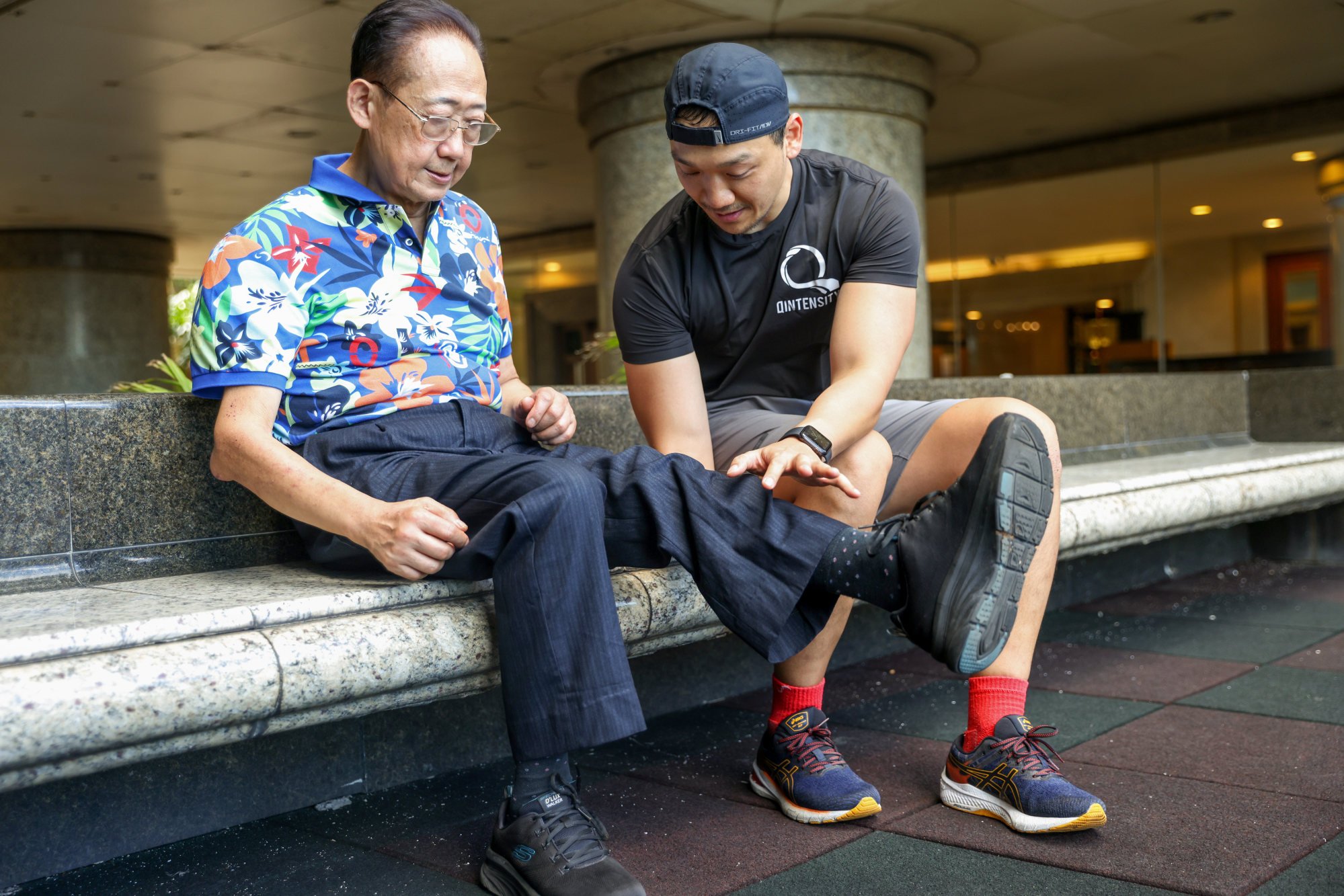
We are generally told to avoid physical activity if in pain, but Chan, who is now 67, was keen to exercise following his operation and worked with personal trainer Kyle Liu Kim-man – a joint, pain and movement specialist and co-founder of Qintensity Fitness, in Hong Kong.

Chan was already a client of Liu’s, and a few months before his knee replacement had employed the latter’s services in the hope that exercising would speed up his recovery after surgery.

Liu developed an intervention programme for Chan, focusing on cardiovascular fitness, muscle strengthening, strength building, flexibility, balance and coordination.

The goal of the programme was to slow down muscle loss and enhance Chan’s overall strength and endurance so that he could go about his day free of pain and with little to no risk of falling.

Chan (left) practises a workout under the instruction of Liu. Photo: Yik Yeung-man

Following surgery, Liu adjusted the programme to help Chan recover faster and increase his muscle strength so that he could start walking again. It included exercises such as seated leg extensions, seated marching, and the “pillow squeeze” – in which one squeezes a pillow between one’s legs to work the inner thighs.

The training sessions took place in Chan’s home.

“I’d never exercised prior to this,” says Chan, whose position as the owner of a jewellery business saw him mostly confined to his desk or crouched over a gemstone-polishing machine.

“My wife suggested I take up exercise before my knee replacement surgery. She exercises regularly and told me how good it makes her feel.”

After his procedure, Chan couldn’t move much because of the pain, but still tried his best to walk using his Zimmer frame, and ride his sitting pedal cycle, which he says allowed him to move his knees without straining them.

Three months later, his knee pain was no longer as intense, and now he can stand and walk for longer periods without needing support or feeling discomfort.

It might seem counterintuitive to exercise when in pain, but research has shown that physical activity can actually help relieve discomfort.

A study published in June 2022 in the journal Arthritis and Rheumatology found that walking for exercise can reduce knee pain among people aged 50 and older who have been diagnosed with knee osteoarthritis, the most common form of arthritis.

It also found that walking for exercise may be an effective treatment to slow the damage that occurs within the joint.

“Being physically active improves our blood circulation, strengthens our muscles, boosts our mood, and enhances our flexibility and mobility,” Liu says.

“These are just a few benefits of exercise, and they all help with pain management as well as allowing the body to move more freely.”

He adds: “One of the main causes of chronic pain is physical inactivity; holding the same posture for a long time without movement can overload our joints and muscles, depending on the area, and increase our risk of developing various pain-related diseases.”

Not everyone who is in pain finds it easy to move; they might even think that physical activity is out of the question, especially if they’ve just had surgery or are injured.

But according to Ally van de Pol, a personal trainer, pain-free performance specialist and head coach at Dragon Fitness and Coaching in Hong Kong, everybody should learn the six human movement patterns – squats, lunges, hinges, pushing, pulling and carrying.

“It’s important that those in pain work with a professional who can help them modify these movements according to their restrictions,” she says.

“Movement should alleviate pain, not add to it.

“For example, if your knees hurt when you squat, I would try to adjust your hip or knee position, perhaps using a box to squat to and using TRX [a suspension training system for Total Resistance Exercises] to support a weaker core and upper body.

“I also often use resistance bands around the knees to support weak hips or behind the knees for Spanish squats.”

Liu advises not to go overboard with exercise if in pain, and that overworking muscles, tendons and ligaments may cause inflammation and worsen the discomfort, and in some cases even tear your ligaments – a problem that requires surgery.

“Very rarely, we also see cases of rhabdomyolysis, when the muscle breaks down from working out excessively without rest. The toxins produced by this breakdown process then travel to the kidneys, where they can cause serious damage.”

For those in pain and wanting to resume physical activity or start an exercise programme, or those who’ve recently had surgery, Liu recommends first seeing a doctor.

With a doctor’s go-ahead, start with a low-impact activity like swimming or walking, gradually increasing the duration and intensity of the exercise as your condition, stamina and fitness improve.

According to Liu, which activity you choose depends on the level of pain you’re experiencing and the pain’s location. If the pain is not too intense, finding the exercise that interests you the most should be a priority because, ultimately, your goal is to build a lifelong exercise habit.

Without regular exercise before and after his surgery, Chan, who has diabetes, believes that his healing “would not have been as thorough” and may have taken longer.

His current workout routine consists of riding his sitting pedal cycle, stretching on a slanted board and on a bed, and walking around 7,000 steps a day.

“If you’ve had knee-replacement surgery like me, it’s important to move, especially during the initial two to three months, even if it’s the last thing you want to do,” he says.

“You need to keep the muscles around your knees flexible, otherwise they will tighten. 

“When you start walking again after your surgery, you may not be in that much pain any more but your knees will stiffen up.”

Thursday, 3 August 2023

3 common causes of shoulder pain and how to treat them

From nebraskamed.com

Like your body’s other mobile joints – hips, knees, ankles, etc. – your shoulders are critical to multiple everyday movements. Almost any action you perform with your arms is done thanks, in part, to your shoulders. That’s why understanding common causes of shoulder pain and how to treat them is vital. The sooner you treat a shoulder injury or illness, the sooner you can return to living as you’re used to.

“The vast majority of adults who present to us in-clinic with an atraumatic shoulder pain fall into three overarching categories: arthritis, shoulder stiffness and rotator cuff disease,” according to orthopaedic surgeon Edward Fehringer, MD. “These three categories constitute approximately 90% of the shoulder pain-related issues we see, especially among those 40 years or older.”


Shoulder arthritis

“Arthritis in the shoulder typically affects the ball and socket or the end of your collarbone,” says Dr. Fehringer. “Shoulder arthritis can come from an old injury, prior dislocation or surgery, osteoarthritis, inflammatory arthritis, or crystalline arthritis like gout or pseudo gout.

Usually, shoulder arthritis – like arthritis in other areas – builds over many years; it’s a slow but progressive disease. So, common symptoms include a progressive ache in your shoulder, some catching and popping (as the cartilage surfaces in your shoulder become less smooth), loss of motion and loss of strength.”

Shoulder stiffness

“If you’re experiencing shoulder stiffness, haven’t had prior surgery, and your flexibility is limited in one or more planes; you likely have shoulder stiffness for some specific reason,” says Dr. Fehringer.

“One of the most common forms of shoulder stiffness is idiopathic frozen shoulder, which is more likely to affect women than men and those with diabetes or hypothyroidism. Those with frozen shoulder will experience pain and stiffness that will incrementally increase before eventually decreasing.

Prior surgery on your shoulder can also result in shoulder stiffness. Such post-traumatic or post-surgical stiffness can result in restricted flexibility to your cell tissues or scarring contributing to stiffness.”

Rotator cuff disease

Rotator cuff disease can include a multitude of causes, including:

  • Tendonitis
  • Calcific tendonitis
  • Tendinosis
  • Tendinopathy
  • Partial-thickness rotator cuff tear
  • Full-thickness tear
  • Retracted tear

“Each of these causes generally presents first with an aching pain that slowly but progressively increases,” says Dr. Fehringer. “Rotator cuff diseases are common because as we age, so do our rotator cuffs, which become more susceptible to small tears and other variables contributing to rotator cuff disease.

Rotator cuff diseases are so common as people age that around the age of 60, most people have a partial-thickness rotator cuff tear. By 65, about 25% of people have a full-thickness tear. Similarly, most of the time, these injuries aren’t from activity-related use but are an aging phenomenon. Almost 80% of patients who develop a full-thickness rotator cuff tear do so without injury.”

Factors that have a more substantial negative impact on the health of your rotator cuff than participating in a sport include:

  • Smoking
  • Drinking
  • Poor nutrition
  • Steroids
  • Diseases
  • Certain types of medications

Diagnosing your shoulder pain

“If you haven’t had prior X-rays or an MRI before seeing me, I will start your appointment with plain X-rays,” says Dr. Fehringer. “Then, I would see you for a physical examination, listen to you describe your issues, ask lots of questions, and review your X-rays or previous studies to develop a working diagnosis.

“From this diagnosis, I would then prescribe the best course of action. Your specific treatment plan will depend on your diagnosis. Fortunately, when someone sees me electively for shoulder pain, we can treat most of these issues non-surgically.”

Treating your shoulder pain

“Maintaining flexibility is very important for treating shoulder arthritis,” says Dr. Fehringer. “Keeping your shoulder’s flexibility for as long as possible while arthritis progresses helps preserve usability and manage pain. Likewise, you can control pain from arthritis with nonsteroidal anti-inflammatories (NSAIDs) or cortisone injections.”

Aside from physical therapy and stretching to maintain flexibility, the only other predictable treatment for shoulder arthritis is shoulder replacement surgery. Still, shoulder replacement surgery works best when it’s the first operation on that shoulder and when your arthritis has progressed to bone-on-bone arthritis.

“As previously mentioned, most of the shoulder stiffness I see is idiopathic, meaning we’re not quite sure what causes the stiffness. Thankfully, we can treat most idiopathic shoulder stiffness through physical therapy, stretching, and pain management through NSAIDs or cortisone injections,” says Dr. Fehringer.

“In rare cases, we can do shoulder manipulation. This procedure entails putting you to sleep for a short time and then stretching the affected shoulder, but there are risks for manipulation like a fracture, rotator cuff tear or dislocation.”

Treating rotator cuff disease will differ slightly based on what’s affecting your rotator cuff. By and large, tendonitis doesn’t need surgery to improve. Similarly, tendinosis and tendinopathy are a function of many variables, but the tendons aren’t torn. Altering your bony anatomy Around those tendons won’t change the tendons or the variables that caused their diseased state.

“Likewise, most partial-thickness tears will heal themselves and usually won’t require surgery. On the other hand, full-thickness tears won’t heal back to the bone on their own and without surgical intervention,” Dr. Fehringer says. “However, most full-thickness tears never undergo surgical intervention because they don’t always cause many symptoms, which isn’t perfectly understood.” 

https://www.nebraskamed.com/orthopaedics/health/conditions-and-services/3-common-causes-of-shoulder-pain-and-how-to-treat-them